The impacts of Relational and Restorative Practice in schools
Project overview
Relational and Restorative Practice (RRP) is concerned with building, maintaining and repairing relationships across the whole school community. It includes both proactive work to strengthen belonging, trust and school culture, and responsive approaches to addressing harm when it occurs.
RRP is not limited to responding to incidents of harm. It is a whole-school approach that seeks to strengthen relationships, build belonging and create a positive school culture through both proactive and responsive practices.
This project will examine the prevalence of RRP adoption in England and whether and under what conditions this approach influences outcomes for schools and teachers.
Why is this important?
The management of pupil behaviour is one of the most pressing problems in English schools. In the National Education Union’s State of Education 2026 survey, two thirds of state-school teachers in England said pupil behaviour has a negative impact on learning in lessons either regularly or all the time. There are impacts on teachers too. Analysis by the National Foundation for Educational Research finds that time spent dealing with pupil behaviour plays a significant role in teachers’ decisions to leave the profession.
In recent years schools have made greater use of suspensions and exclusions to manage behaviour. More than 900,000 suspensions and almost 10,000 permanent exclusions are now regularly issued each year in England, and the most common reason for both is persistent disruptive behaviour. The burden falls unevenly: children eligible for free school meals and children with special educational needs are suspended and excluded at several times the rate of their peers.
The policy context is focusing more clearly on these issues. The government’s February 2026 white paper Every child achieving and thriving commits to refresh guidance on suspensions and permanent exclusions and proposes a set of strategies that aim to keep pupils in school and repair relationships after things go wrong.
The Theory of Change below describes what Relational and Restorative Practice (RRP) aims to do, how, and what impacts it may have. Many English schools already adopt it, but nobody knows how many, or what difference it makes. This project aims to find out.
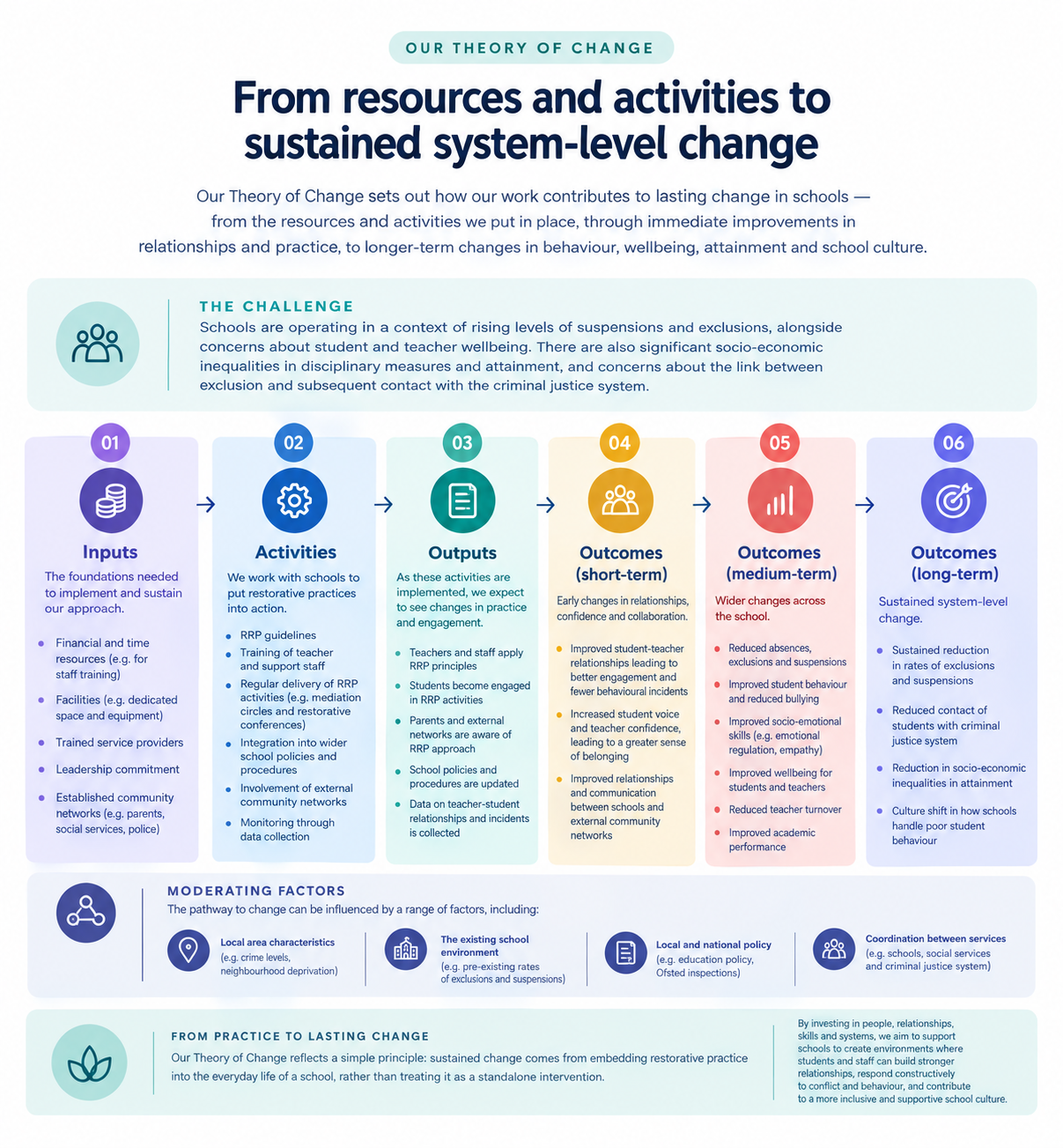
Our Theory of Change
(opens in a new window)
What we are doing
The project runs from April 2026 to March 2028 and has two parts.
Workstream A — how widespread is RRP in English schools?
Many schools in England use relational and restorative practices (RRP), but there is currently no clear national picture of their prevalence. State-funded schools have a statutory requirement to publish a behaviour policy. In this part of the project, we will collect published behaviour policies from a representative sample of 10% of primary and secondary schools in England. In collaboration with the Restorative Justice Council, we will use large language models (LLMs) to identify which schools adopt RRP and the extent to which these practices are embedded in their policies. This will provide a national estimate of the prevalence of RRP across English schools and can be used to document how adoption varies by local area context, school phase, school size, and school governance.
Workstream B — what difference does it make?
Our evaluation of the impact of RRP on pupil and teacher outcomes proceeds in two steps.
James Simon, Chief Executive of the Restorative Justice Council (RJC) is a co-investigator on the project and convenes a Scientific Circle of around 25 to 30 members — school staff, consultants who have supported schools through implementation, trainers, and academics working in the field. Schools are drawn from the RJC’s existing Register of Restorative Schools and from schools that have demonstrated a commitment to restorative practice. They are assessed against the RJC’s Registered Restorative Educational Setting framework, which looks at five things: whether restorative values are reflected in the school’s vision and culture; whether staff are trained and supported, including new arrivals; how often and how well restorative approaches are used, both proactively and in response to conflict; whether they are applied equitably across a diverse pupil population; and whether pupils, parents and the wider community are involved in shaping them. The Circle draws on in-depth case studies, published school documents and other records, as well as qualitative interviews with the senior leadership teams. It also collects information about when a school adopted RRP and what other behaviour-related support is in place.
The evaluation team – consisting of researchers at the University of Essex and the University of St Andrews – then compares what happened in those schools with what happened in otherwise similar schools, before and after adoption, looking at pupils’ attainment, attendance, suspensions and exclusions, and later contact with the criminal justice system, and at whether teachers stay. Because schools adopted RRP at different points over the past decade, we can separate the effects of a restorative approach from wider changes affecting all schools.
Governance structure
The project is overseen by an Advisory Group of eight to ten members. Its members are drawn from academia, school practice, professional bodies and unions, policy, and civil society organisations.
The Advisory Group provides constructive challenge at each stage. It reviews the analysis plans before the research begins, monitors progress against milestones, and comments on the final reports and academic outputs before they are published. It also advises on how findings should be interpreted and where they are most relevant to policy and practice.
Alongside this external oversight, roles within the project are deliberately separated. The Restorative Justice Council and the Scientific Circle identify and assess restorative schools; the evaluation team at the University of Essex and the University of St Andrews carries out the analysis. Neither takes part in the other’s work beyond specifying what data is required.
The analysis plan will be registered publicly through the Open Science Framework before the evaluation team receives the list of restorative schools.
The project has been approved by the University of Essex Faculty of Social Sciences Ethics Subcommittee.
How will it make a difference?
Findings will be shared with teachers, headteachers, unions, RRP training providers, non-governmental organisations, policymakers, and the public. Dissemination activities will include interim and final reports, policy briefs, and workshops. Ultimately, the project aims to inform practitioners and policymakers by highlighting how RRP influences outcomes for pupils and teachers, and by exploring how the effectiveness of RRP depends on mode of implementation, other behavioural policies, and the broader school context.
Project updates
- Paulo Morais joins the team to work on identifying school behavioural policy documents, 14 July 2026
- First meeting of the Scientific Circle, 21 July 2026
Start date
01 Apr 2026
End date
31 Mar 2028
Funder
Nuffield Foundation