The impacts of Relational and Restorative Practice in school
Project overview
What do Restorative Justice and Relational Practice in schools mean?
Restorative Justice and Relational Practice (RRP) is an approach to building positive, respectful and supportive relationships across the whole school community. Rather than focusing only on rules, sanctions or punishment when something goes wrong, RRP encourages people to understand what has happened, who has been affected and what can be done to repair relationships and put things right. It gives students and staff opportunities to listen to one another, take responsibility, express their needs and find constructive ways forward. In schools, this can include approaches such as restorative conversations, mediation, circles and restorative conferences, alongside everyday practices that strengthen trust, communication and student voice. By embedding these principles into school culture, policies and relationships, RRP aims to create more inclusive environments where young people and adults feel heard, valued and able to contribute.
This project will examine whether Relational and Restorative Practice (RRP) can help schools manage behaviour in ways that are less damaging and fairer than suspensions and permanent exclusions.
Why is this important?
Evidence from various sources suggests that poor behaviour in schools has risen. For example, the NASUWT found that 89% of teachers say pupil violence and disruptive behaviour has increased in recent years. Additionally, according to data from the Department for Education, 52% of teachers and school leaders cite pupil conduct as a reason for leaving the state sector in 2024, up from 41% in 2023. Schools have correspondingly made greater use of exclusion to manage behaviour. In 2022/23 England recorded 9,400 permanent exclusions, a 44% increase from 2021/22, and the highest annual number on record.
The emphasis of RRP is on making, maintaining, and repairing relationships whenever these are damaged by harmful or disruptive behaviours, and ensuring everyone has a voice. The approach has been adopted in English schools since the late 1990s. The approach has developed into a whole-school proactive strategy aimed at improving school climate and student-teacher relationships. However, the evidence base on the efficacy of RRP is thin.
What does it involve?
The research team therefore have two primary aims:
- Document the prevalence of RRP across 10% of English primary and secondary schools.
- Evaluate whether RRP leads to better outcomes for pupils and teachers in terms of exclusions, academic progress, post-16 trajectories, contact with the criminal justice system, and teacher retention.
In pursuit of the first aim, a national representative sample of schools will be selected from the government’s Get Information About Schools database and systematic text analysis will identify references to RRP and generate an RRP score for intensity of implementation.
For the second aim, the causal impact of RRP on pupil and teacher outcomes will be evaluated using matched difference-in-difference methods, comparing fully restorative schools with similar non-restorative schools.
How will it make a difference?
Findings will be shared with teachers, headteachers, unions, RRP training providers, non-governmental organisations, policymakers, and the public. Dissemination activities will include interim and final reports, policy briefs, and workshops. Ultimately, the project aims to inform practitioners and policymakers by highlighting how RRP influences outcomes for pupils and teachers, and by exploring how the effectiveness of RRP depends on mode of implementation, other behavioural policies, and the broader school context.
Team members
Professor Emilia Del Bono
Professor of Economics - University of Essex
Professor Del Bono is a world-leading expert on the nature, causes and consequences of disparities in children’s human capital that lead to inequalities later on in life. Her recent work has included the study of children's socio-emotional development and impact on later life.Dr Angus Holford
Senior Research Fellow - University of Essex
Dr Holford's research agenda is focused on the mechanisms in determining gender, socio-economic and ethnic differences in health, educational attainment and early labour market outcomes. At present, this means one strand of work focusing on the impacts of Universal Free School Meal programmes, school breakfasts and local food environments; and another on the economics of Higher Education, including analysing a ground-breaking longitudinal study of student life.Dr Luca Favero
Lecturer in Economics - University of St Andrews
Dr Favero is Assistant Professor at the University St Andrews and Research Associate with the ESRC Research Centre on Micro-Social Change at the Institute for Social and Economic Research, specialising in the economics of education.James Simon
Chief Executive - Restorative Justice Council
Jim Simon is the Chief Executive of the Restorative Justice Council and an experienced head teacher with 21 years’ service within education. Alongside this he has worked closely with youth offending services and the police force in developing restorative practices within educational and youth settings. He is an experienced practitioner and trainer within restorative practices and has led the strategic development and implementation of these services within educational and youth settings.Dr Paul Garcia Hinjosa
Senior Research Officer - University of Essex
Dr Garcia Hinjosa's research primarily focuses on educational attainment, mental health, and criminal justice, particularly during childhood and adolescence. He was recently awarded a fellowship funded by Administrative Data Research UK (ESRC) to identify early socio-emotional traits and other contextual factors that may increase the risk of children engaging in criminal activities as they transition into adolescence. This research uses linked data from the Ministry of Justice and the Department for Education.Louise Cullen
Head of Communications and Engagement, Institute for Social and Economic Research - University of Essex
Louise is providing the communications expertise for this project.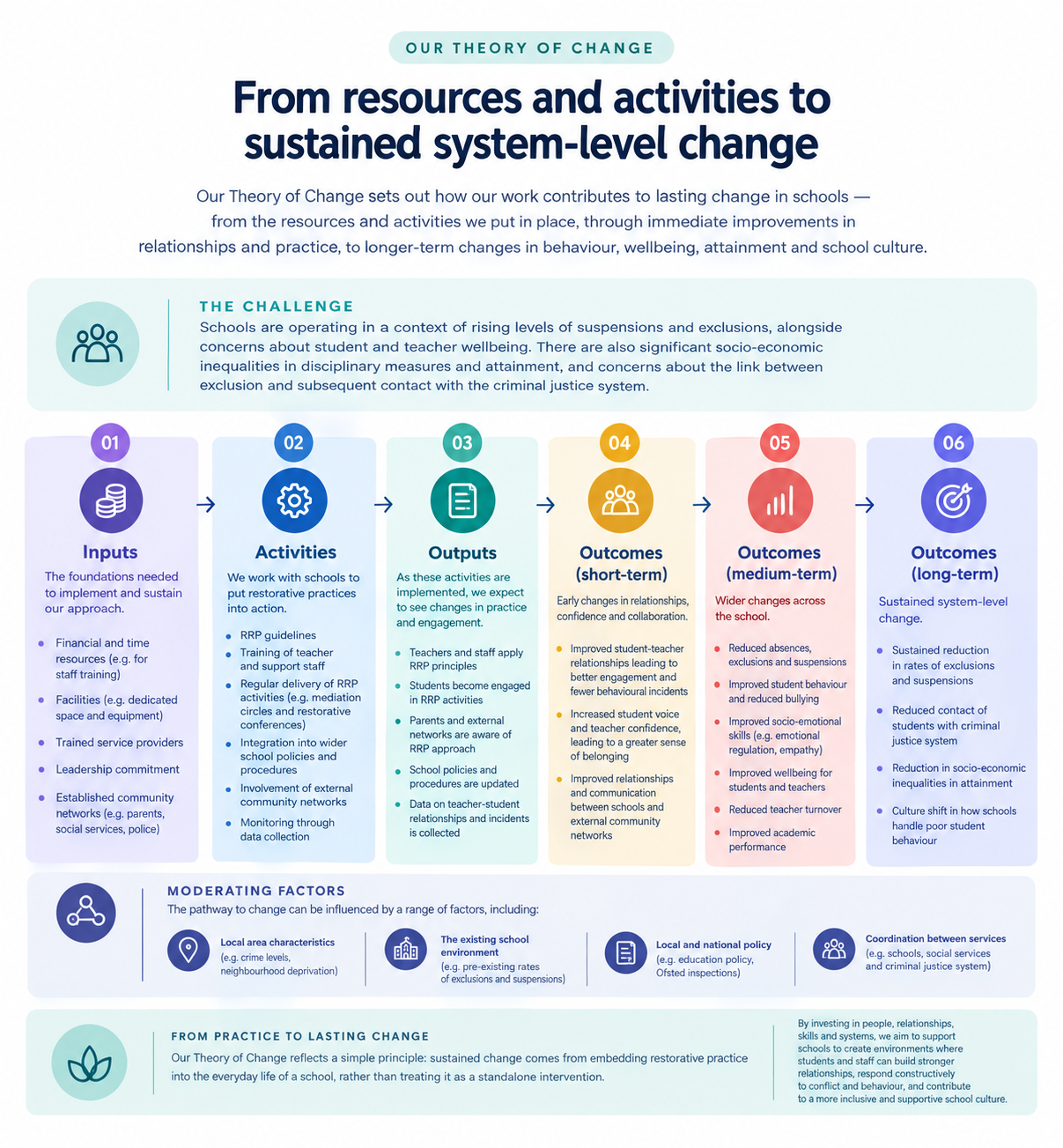

Start date
01 Apr 2026
End date
31 Mar 2028
Funder
Nuffield Foundation