
Technology adoption and exporting usually move together. New evidence on AI suggests that, for now, this holds only for exporters of services.
Combining AI and exports could give the UK a double gain on growth. Exporters are among the most productive firms in the UK, and net exports add directly to GDP. But a 2026 study published by ISER at the University of Essex, AI Adoption and Workforce Change in SMEs, points to a more complicated picture. Services exporters lead on AI adoption, in both uptake and depth of use, while goods exporters are no further ahead than comparable firms that do not trade internationally at all (Bharier, Etheridge and Morais, 2026).
The puzzle
Exporting and innovation tend to go together. Foreign markets are costly to enter, so exporting acts as a filter: only firms productive enough to cover the initial cost end up doing so (Melitz, 2003). Once abroad, firms are pushed to innovate in two ways: exposure to global competition pressures them to learn and improve (De Loecker, 2007), and larger markets raise the pay-off from investing in new technology, since the fixed costs of upgrading can be spread over far more sales (Bustos, 2011; Lileeva and Trefler, 2010). The evidence for the UK is broadly consistent with this: firms that exported goods and/or services between 2011 and 2022 were 28.5 per cent more productive than comparable non-exporters, after controlling for observable characteristics (ONS, 2025). On this logic, we’d expect to see internationally active firms in general ahead on AI adoption.
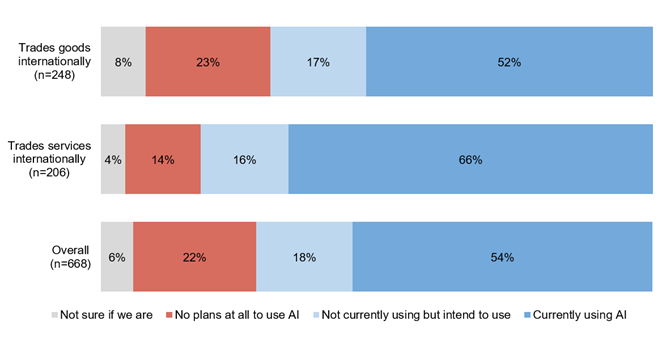
The ISER paper suggests only one kind is. Across 668 firms surveyed by the British Chambers of Commerce (BCC), 54 per cent reported using AI. Among firms trading services internationally, this rose to 66 per cent. But for those trading goods it was 52 per cent, no higher than among firms that do not trade internationally at all.
Graph 1: The proportion of firms reporting AI use.
Source: ISER/British Chambers of Commerce
Today’s AI suits some sectors more than others
This gap between goods exporters and services exporters may be partly explained by what today’s AI is actually good at: office-based, cognitive work such as writing, programming and software development. Exposure to generative AI is concentrated in occupations that perform these tasks. In one controlled experiment, generative AI cut the time professionals took on short writing tasks by 40 per cent, while raising quality by 18 per cent (Noy and Zhang, 2023). In the ISER study, IT and digital firms had the highest AI adoption rate, at 78 per cent, against 45 per cent for manufacturers, more than a quarter of whom had no plans to adopt at all.
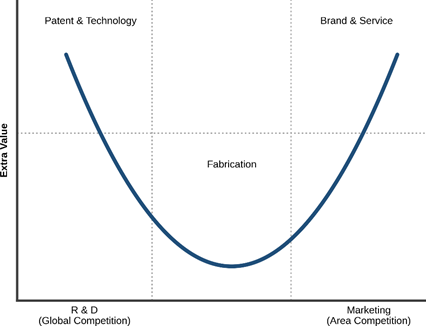
The ‘smile curve’ suggests why manufacturing might differ. Value concentrates at the information-heavy ends of the production chain, in the research and design before manufacture, and in branding and after-sales service afterwards (Shih, 1996). Fabrication, the core of a manufacturing business, sits in the middle, and it is where gains are harder to win with today’s off-the-shelf AI tools, compared with cognitive tasks.
Graph 2: The Smile Curve.
Source: Stan Shih
A specialist manufacturer is likely to need a bespoke system. Guiding a robotic arm, for instance, needs models trained on robot movement and wired into the machine. That is a fundamentally different investment from buying a Copilot licence. Manufacturers have made this kind of shift before – industrial robots added around 0.36 percentage points a year to labour productivity growth across 17 countries between 1993 and 2007 (Graetz and Michaels, 2018). But repeating this scale of change means a higher cost base for potentially smaller marginal gains.
Sector is not the whole story
Comparing firms that look alike on paper, by size, productivity and sector, the ISER study shows that firms trading services internationally remain significantly more likely to use AI, while trading goods internationally shows no measurable association. A firm that trades goods internationally is no more likely to use AI than a similar firm that does not, regardless of sector.
The divide also shows in how far AI has changed firms, not just whether they use it. Among AI users, and comparing similar firms, those trading services internationally are much more likely to have restructured job roles because of AI than those trading goods. The gap in adoption also flows into a gap in outcomes.
What else is different about goods trade?
The applicability of today’s AI to certain types of work may explain much of the gap, but there may be factors unique to trading goods worth exploring. One broader issue, for instance, is that trading goods has become harder than trading services over the past decade, through Brexit, supply chain breakdowns and global conflicts. In 2025 services made up 59.1 per cent of UK exports, and the UK ran a £203.8 billion services surplus against a £225.6 billion goods deficit. Since 2019, the UK’s export mix has shifted from goods towards services about three times faster than in the years before, and the Resolution Foundation attributes this mainly to a slump in goods exports, the sharpest fall of any G7 country, rather than to a surge in services (Hale, Hunsaker and Pittaway, 2026).
One of the shifts in the last decade, Brexit, fell disproportionately on goods firms: new customs checks, paperwork and border delays. Analysis since the Trade and Cooperation Agreement has found that the range of goods the UK exports to the EU has fallen by 53.8 per cent, and export values by 16.5 per cent (Du, Shepotylo and Shi, 2026). The same study tests directly for selection and attributes the pattern instead to supply-chain lock-in, with firms held in the market by sunk costs, such as certified production lines, rather than by being more productive. The scale of the post-Brexit rise in barriers may have choked off the supply of new exporters needed to drive the exporter-innovation cycle.
What might close the AI adoption gap for goods exporters?
The evidence points to three broad constraints: the technology itself, the cost of trading goods across borders, and firms’ ability to identify practical uses for AI. Some of these sit within UK policy, while others depend on how the technology develops globally.
The technology. General-purpose robots could transform the difficult fabrication phase for the average manufacturer, but robots that do productive work at scale are still far off. Many humanoid robots sold in 2025 went to research institutions and companies gathering data for AI models, not to productive work (Sterling, 2026). China, by contrast, has made humanoids a frontier priority, backed by a state venture fund expected to draw nearly $138 billion over 20 years (International Federation of Robotics, 2025).
Trade policy. AI could lighten some of the paperwork load caused by the UK’s withdrawal from the EU, but only policy can remove it, through additional trade agreements to reduce trade barriers. Broader digitalisation of global trade processes and documentation could also help cut the time and cost of moving goods across borders, a burden that falls disproportionately on goods trade compared with services trade. If lower trade costs encouraged more firms to enter export markets, it could help restore the exporting-innovation cycle.
Sharing knowledge. In the 2024 wave of the BCC AI survey, 19 per cent of services exporters said they were ‘completely confident’ they could apply new AI technologies, compared with 6 per cent of exporting manufacturers (BCC, 2024). If that gap is part of the explanation, the fix is seeing it done – peer examples, practical training and support tied to real tasks. Business-facing channels already exist, such as the BCC’s own AI Academy and Trade Accelerator, the government’s Made Smarter adoption programme for manufacturers, the AI Skills Boost initiative and Innovate UK’s business support scheme.
Exporting tends to be a strong guide to which firms adopt new technology. For AI, so far, that guide applies more to services exporting. Task fit, trade costs, lock-in and a shortage of know-how may all play a part in the gap for goods. Supporting growth among UK exporters means recognising that they are moving at different speeds, working out which constraints matter most, and which of those can actually be resolved.
David Bharier is Deputy Director at the British Chambers of Commerce and a Policy Fellow at MiSoC, University of Essex.
Bharier, D., Etheridge, B. and Morais, P. (2026) ‘AI Adoption and Workforce Change in SMEs’, ISER Working Paper No. 2026-1. Colchester: University of Essex.
Bustos, P. (2011) ‘Trade liberalization, exports, and technology upgrading: Evidence on the impact of MERCOSUR on Argentinian firms’, American Economic Review, 101(1), pp. 304-340.
De Loecker, J. (2007) ‘Do exports generate higher productivity? Evidence from Slovenia’, Journal of International Economics, 73(1), pp. 69-98.
Du, J., Shepotylo, O. and Shi, Y. (2026) Supply Chain Lock-in and the Selective Destruction of EU-UK Trade, Working Paper No. 074. Manchester: The Productivity Institute and Centre for Business Prosperity, Aston University.
Graetz, G. and Michaels, G. (2018) ‘Robots at work’, Review of Economics and Statistics, 100(5), pp. 753-768.
Hale, S., Hunsaker, S. and Pittaway, S. (2026) Leaving EU Behind: How Britain Lost Its Trading Edge and Whether Brexit Is to Blame. London: Resolution Foundation.
International Federation of Robotics (2025) China to Invest 1 Trillion Yuan in Robotics and High-Tech Industries. Frankfurt: IFR.
Lileeva, A. and Trefler, D. (2010) ‘Improved access to foreign markets raises plant-level productivity… for some plants’, Quarterly Journal of Economics, 125(3), pp. 1051–1099.
Melitz, M.J. (2003) ‘The impact of trade on intra-industry reallocations and aggregate industry productivity’, Econometrica, 71(6), pp. 1695–1725.
Noy, S. and Zhang, W. (2023) ‘Experimental evidence on the productivity effects of generative artificial intelligence’, Science, 381(6654), pp. 187–192.
Office for National Statistics (2025) Trade and productivity in British firms: 2005 to 2022. Release date: 14 August 2025. Available at: https://www.ons.gov.uk/economy/economicoutputandproductivity/productivitymeasures/articles/tradeandproductivityinbritishfirms/2005to2022
Shih, S. (1996) Me-Too is Not My Style. Acer Foundation.
Sterling, T. (2026) ‘Humanoid robot sales tally hit 7,000 globally last year’, Reuters, 21 September, citing International Federation of Robotics data