
In 2024, 162,000 people were granted Indefinite Leave to Remain (ILR) in the UK. The UK government wants to make that harder. Its 2025 Immigration White Paper proposes doubling the residency requirement for permanent settlement from five to ten years, a change that would, if enacted, affect hundreds of thousands of people already living and working in the UK.
It is important to be clear about what this policy does and does not do. ILR and citizenship are not identical. ILR grants permanent residency, access to public funds, and unrestricted access to public services. Yet, citizenship goes further, conferring voting rights, a British passport, and the security of residency rights that cannot be lost through prolonged absence abroad. The proposed reform is therefore primarily a change to the settlement pathway, not directly to citizenship.
Why, then, does this matter? The Home Office has itself identified positive immigrant fiscal contributions as a policy goal. But there is a less-examined question on the other side of the ledger. What if making permanent residence harder to obtain actually works against that goal, not by changing who comes in, but by changing what happens to those already here?
That is the question this post addresses. Research on the effects of settlement barriers is still limited, but what we know from evidence on both ILR-equivalent statuses and on naturalisation consistently points in the same direction. Raising barriers to long-term legal status suppresses integration and human capital investment. Delay integration, and the fiscal arithmetic starts to look rather different.
Tighter Rules, Fewer People Settling: The Evidence Is Unambiguous
The most immediate effect of raising barriers to permanent status is a reduction in take-up. This is not surprising: when the costs of obtaining legal security rise, fewer immigrants cross the threshold, thus becoming eligible. What is striking is how large and consistent the effects are across different countries and different types of reform.
Peters and Vink (2023) provide compelling causal evidence, though it is noteworthy that their study concerns naturalisation. Exploiting variation in dual citizenship legislation across the complete migrant populations of the Netherlands and Sweden, they find that the reintroduction of a renunciation requirement in the Netherlands in 1997 reduced naturalisation rates by 6.4 percentage points, whilst Sweden’s abolition of the same requirement in 2001 raised them by 6.7 percentage points. The effects are almost perfectly symmetric. A policy change goes in, naturalisation rates move in lockstep. Direct evidence on settlement barriers points in the same direction. Khan and Lundberg (2023) find that a reduction in the qualifying period for permanent residency for doctoral students in Sweden, from eight to four years, increased the likelihood that they would remain in the country. The UK’s proposed reform works through this mechanism, i.e., by lengthening the path to permanent status, so fewer people will reach it or remain long enough to try.
Settlement and Naturalisation as Economic Catalysts
If fewer people achieving permanent status were simply a demographic fact, it might be of limited fiscal consequence. However, evidence from across Europe, exploiting actual changes in requirements, including waiting period, consistently shows that legal security, i.e., having settlement status and citizenship, has direct, positive effects on immigrants’ labour market outcomes. The bulk of evidence concerns naturalisation rather than settlement directly, but the underlying mechanisms are common to both, making this research an informative, if imperfect, guide to the likely costs of settlement barriers.
Quasi-experimental evidence from Germany and France tells a consistent story. Gathmann and Keller (2018) find that a seven-year reduction in the waiting period for citizenship raises female employment by 3.5 percentage points and earnings by around 10% — equivalent to three additional years of labour market assimilation. Govind (2020) finds that naturalisation through marriage in France led to a 29% increase in annual earnings, driven by more hours worked and higher wages, partly by signalling language proficiency and reducing hiring discrimination. Across both studies, the mechanism is the same: the prospect of belonging shapes incentives to invest in host-country-specific human capital, well before citizenship is granted.
Direct evidence on settlement barriers points in the same direction. A reduction in the qualifying period for permanent residency raised language investment and employment among immigrants and their partners in Sweden, whilst increased work and language requirements for permanent residency resulted in lower employment and unchanged language acquisition among refugees in Denmark (Arendt, Dustmann, and Ku, 2025; Khan and Lundberg, 2023). Although the higher language requirement aims to incentivise immigrants’ investment in the local language skills, the reform had the opposite of its intended effect: rather than incentivising investment, the stricter requirements appear to discourage refugees, as meeting the new bar seemed out of reach.
Why does the prospect of settlement and citizenship matter so much? Adda, Dustmann, and Görlach (2022) provide the underlying mechanism of immigrants’ re-migration decisions. They show that immigrants who expect to stay longer invest more in host-country specific skills, including language, vocational training, and familiarity with local institutions. Notably, they also find that policies, which restrict or condition residence, do not merely delay integration; they actively reshape immigrants’ incentives to invest in their futures in the host country, and alter who chooses to stay. A policy that keeps the finish line further away does not simply delay the reward — it changes the race itself.
Our Research: Connecting the Chain
The studies above establish two links separately: policy affects take-up of permanent status and naturalisation, and legal status affects economic outcomes. Our ongoing research connects these links explicitly, within a single, consistent empirical framework.
Using the Netherlands’ 1997 renunciation reform as a natural experiment, the same policy studied by Peters and Vink, we estimate the downstream consequences of the resulting decline in naturalisation on immigrants’ economic performance. Preliminary findings point to a measurable and causally identified deterioration in employment probability among those affected. The chain holds: restrictive policy reduces take-up, and reduced take-up translates into weaker labour market outcomes (Figure 1). For the UK, this suggests the proposed residency extension would not merely slow naturalisation — it would likely suppress the economic contributions of those it affects.
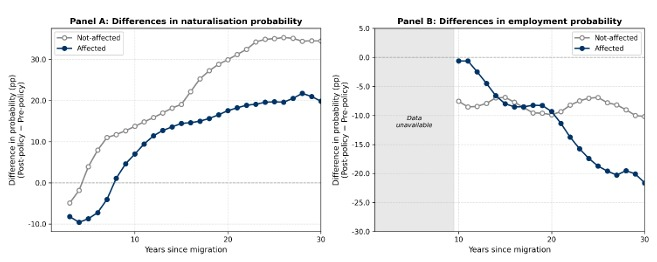
Figure 1: Gaps in Naturalisation and Employment Probability (Post-Policy vs. Pre-Policy)
Note: Panel A shows that while naturalisation rates rose for both groups after the policy change, migrants subject to the new requirements (Affected) naturalised at consistently lower rates than those who were not (Not-affected), reflecting the dampening effect of stricter requirements. Panel B shows that this gap in naturalisation translated into a deterioration in employment probability among the Affected group, a pattern not seen among the Not-affected, suggesting that the employment gap is driven by the policy change rather than broader trends.
The consequences may extend further still. When naturalisation is delayed or deterred, the effects on parents are not limited to employment and earnings. As the evidence on human capital investment suggests, immigrants who face greater uncertainty about their future in the host country also invest less in host-country-specific skills. This has consequences not only for their own productivity but also for the next generation: Parents with weaker host-country human capital are less able to support their children’s engagement with the education system, independent of the financial constraints that lower earnings impose. Evidence also points to consequences beyond the first generation. Longer periods of visa insecurity are associated with poorer child mental health and reduced long-term resilience in immigrant families (Ratnamohan et al., 2023), while parents’ citizenship status has been shown to directly shape the citizenship trajectories of their children (Labussière and Vink, 2020).
Taken together, these channels suggest that barriers to naturalisation and settlement may generate a compounding disadvantage across generations — in labour market participation, human capital accumulation, and civic integration. If delayed naturalisation carries forward into the second generation in this way, the long-run fiscal costs could be considerably larger than short-term headcount calculations would suggest.
A Policy in Tension with Its Own Goals
The Home Office wants immigration to pay its way, which is a reasonable goal. However, the evidence suggests that settlement or citizenship is among the most effective tools for achieving this, and restricting access to it may undermine the fiscal outcomes the government seeks. Some might argue that stricter residency requirements could deter short-term migration or reduce the pressure on public services, and that prioritising controlled migration flows is itself a legitimate policy objective. Nevertheless, this perspective may overlook the broader implications for long-term integration and fiscal contributions. Therefore, although residency requirements should not be entirely unconstrained, policy trade-offs require thorough, evidence-based scrutiny that considers not only migration inflows but also the experiences and outcomes of those already living in the UK, as well as their children. A reform that reduces inflows while impeding the integration of current residents may ultimately undermine the UK’s long-term interests, even if it appears beneficial on paper.
The question is not only how many people become permanent residents and citizens, but it is what legal status does to the people who hold it, and what its absence does to those who cannot.
This post draws on ongoing research into the economic consequences of naturalisation policy. We welcome engagement from policymakers, journalists, and researchers with an interest in this area. For further information, please get in touch.
References
Adda, J., Dustmann, C., and Görlach, J.-S. (2022). The dynamics of return migration, human capital accumulation, and wage assimilation. Review of Economic Studies, 89(6), 2841–2871.
Arendt, J. N., Dustmann, C., & Ku, H. (2025). Permanent residency and refugee immigrants’ skill investment. Journal of Labor Economics, 43(2), 293-318.
Gathmann, C., and Keller, N. (2018). Access to citizenship and the economic assimilation of immigrants. Economic Journal, 128(616), 3141–3181.
Govind, Y. (2020). Is naturalisation a passport for better labor market integration? Evidence from a quasi-experimental setting. Job Market Paper, INED / Paris School of Economics.
Home Office (2025). Restoring Control over the Immigration System. Immigration White Paper, May 2025.
Khan, A., & Lundberg, E. (2023). Permanent Residency Policy and Skilled Immigration: Evidence from a Swedish Reform. Available at SSRN 4594690.
Labussière, M., and Vink, M. (2020). The intergenerational impact of naturalisation reforms: the citizenship status of children of immigrants in the Netherlands, 1995–2016. Journal of Ethnic and Migration Studies, 46(13), 2742–2763.
Peters, F., and Vink, M. (2023). Heterogeneous naturalisation effects of dual citizenship reform in migrant destinations: quasi-experimental evidence from Europe. American Political Science Review, 1–8.
Ratnamohan, L., Silove, D., Mares, S., Krishna, Y., Hadzi-Pavlovic, D., & Steel, Z. (2023). Breaching the family walls: Modelling the impact of prolonged visa insecurity on asylum-seeking children. Australian & New Zealand Journal of Psychiatry, 57(8), 1130-1139.